

Written by: Laura Benitez, Joanna Medina, and Kayla Muzquiz
Texas has it all! There are canyons, mountains, beaches, rivers, and plains. San Antonio extends from the Hill Country to the Southside region which includes oak to mesquite trees, and cacti. If you live in the Southside of San Antonio or if you’re a current student at Palo Alto College, do you ever wonder what is under your feet? For students and faculty at Palo Alto, walking between buildings on campus may be an everyday routine. Did you know that on the western part of Palo Alto, the orange section on the map, sits on a type of rock formation underground that is known as the Wilcox Group? You may ask, why is this important? Well, the Wilcox Group provides vital freshwater, gas, and oil that is beneficial for current and future residents, and it is right under our feet!
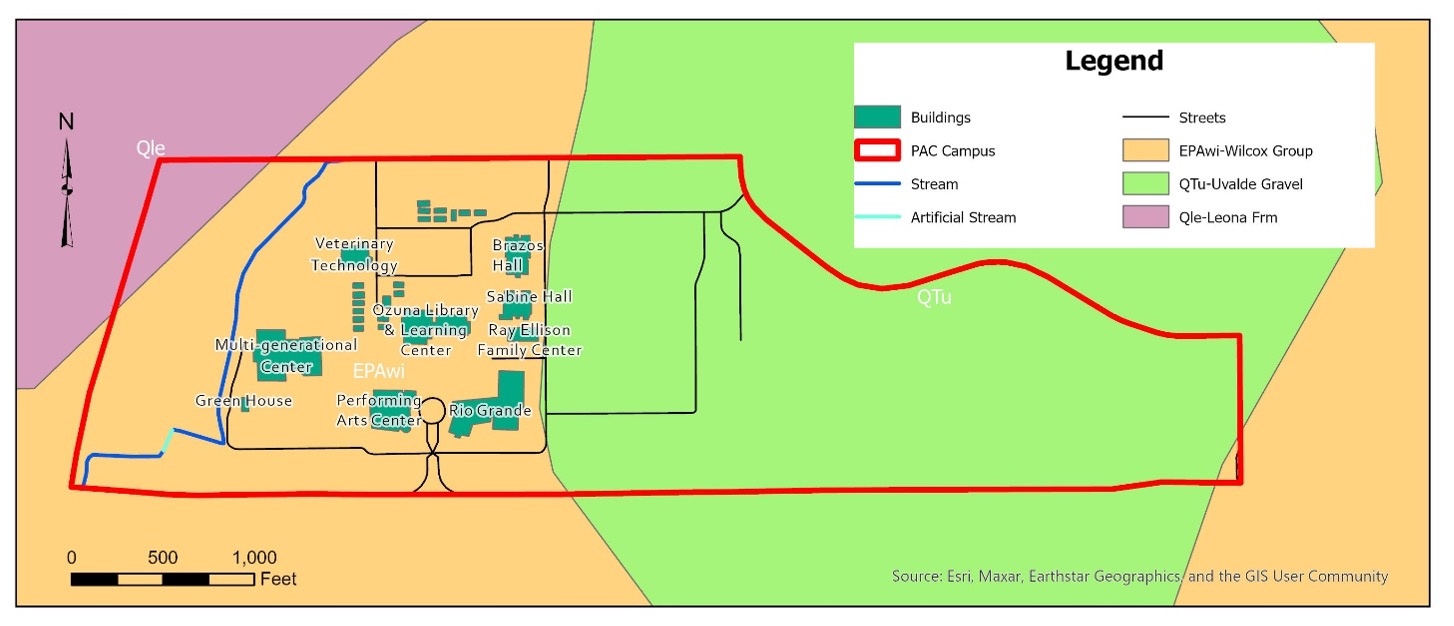
The Wilcox Group is a source of drinking water because it stores water underground in the Carrizo-Wilcox Aquifer, which is not as well-known as the Edwards Aquifer. The Wilcox is known for its abundance of oil and natural gas deposits, making it a significant resource of energy for the community. Scientists also gather important information when digging for resources from the Wilcox to help better understand past climate patterns. This information will help us better understand future climate changes that affect the heat and the amount of rain we experience in San Antonio. This all ties into our communities. For example, how much water there is available and the longevity of it. According to the San Antonio Water System (SAWS) for the year 2023, the Carrizo-Wilcox Aquifer produced a volume of 5700 Acre Feet (AF) of water for our use. That is equivalent of 4,318 football fields at 1-foot depth worth of water.
The Wilcox is generally made up of mostly sediment which are fragments of rock. These sediments get deposited on top of each other and then become highly compacted and cemented over time. This process creates reservoirs that store water, oil, and natural gas. The open spaces that store these resources are called pores. Rocks and sediments have different amounts of pore space. How well the pores are connected determines how easily the fluid can move through the rock.
To gain a better understanding we interviewed Dr. Peter Flaig, a geologist at the Bureau of Economic Geology in Austin, who is a leading expert on the Wilcox Group. In an analogy about pore space, Dr. Flaig stated, “Imagine a perfect round sand grain (they’re not), blow them up to the size of basketballs, then fill the entire room with them. There’s about 40% that is air.” The Wilcox is sedimentary rock consisting of sandstone, mudstone, and lignite in the image referenced below. The sandstone is made up of sand-sized grains and is the main rock for the aquifer. Mudstone is made of clay and silt (think of mud), that seals the water at the bottom of the aquifer. Lignite is brown coal, which can be burned for energy, that originates from plant debris that accumulated in bogs, swamps and marshes.
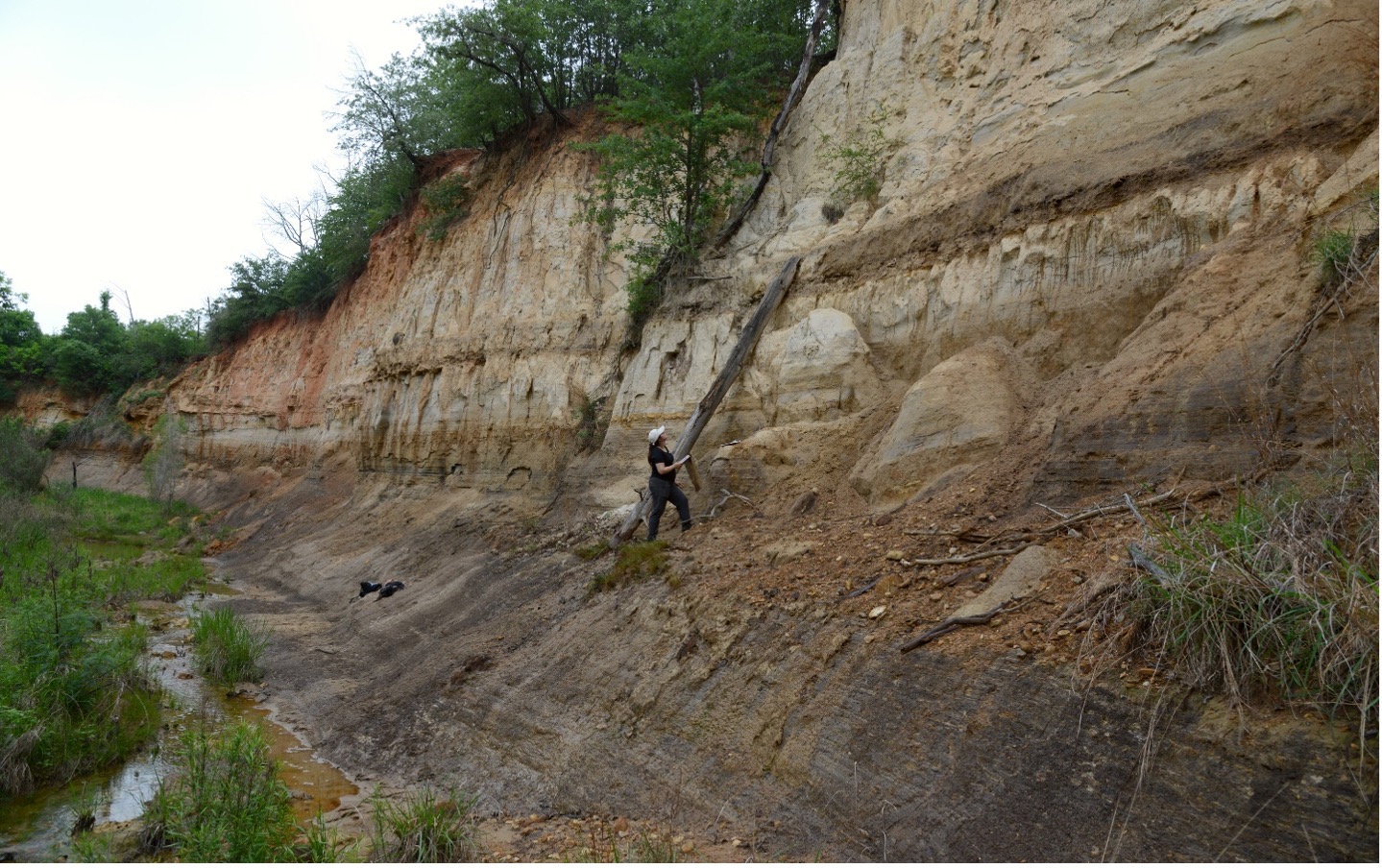
The Wilcox Group has been around a very long time.
Where did all the sediment that formed the rocks come from? “When you drive around and you see all those big limestones up in the hill country, those were all deposited in that giant interior seaway”, Dr. Flaig explained. “The mountains provided the source of the sediment and were eroded by rain and wind and the many rivers along the way made their way into the ocean. All of the sediments from the Wilcox are pretty much sourced from around the ancient Rocky Mountain area, traveling through river systems that ended up in Gulf of Mexico.” Today, the Wilcox as a rock formation is found throughout the Gulf Coast region of the United States, including South Texas.
With San Antonio growing at a rapid rate it is important to think about sustaining our limited resources of water, oil, and gas. Knowing more on this matter can help you in choosing how to take better care of your environment that we all depend on. The Wilcox Group also has the potential for further exploration and development, with new technologies and techniques constantly being developed to extract resources more efficiently and sustainably. By continuing to invest in the study and utilization of the Wilcox Group, South Texas can benefit from its valuable resources for years to come!
This article was written as part of the National Science Foundation-funded GeoEngage Program (2119446) grant in conjunction with University of Texas at San Antonio and Palo Alto College.
Source:
Castro, M. C., and P. Goblet, Calibration of regional groundwater flow models: Working toward a better understanding of site-specific systems, Water Resources Research, 39(6), 1172, doi:10.1029/2002WR001653, 2003.
Author Bios:


Joanna Medina’s Bio: Researcher participant, majoring in education.
 PAC Student Media